
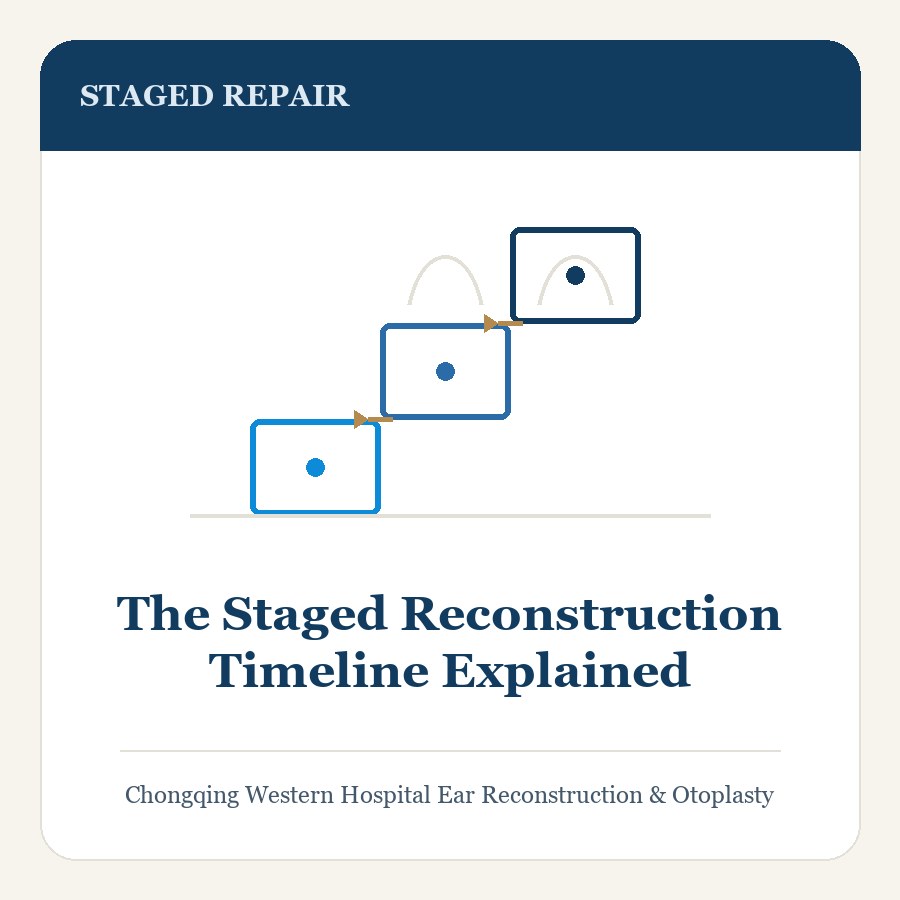
In short. What happens at each stage of cartilage ear reconstruction, why the intervals between operations are treatment rather than delay, and how long the whole sequence takes.
Key points
- The gap between stages, commonly three to six months, is not a delay while a surgeon is busy.
- It is the time the tissue needs.
- Swelling must resolve, the skin must soften, the graft must take firmly, and the result must stabilise enough that the next stage can be planned on what is actually there rather than on what was hoped for.
Cartilage-based ear reconstruction is not one operation but a sequence, and the most common misunderstanding patients bring to a first consultation is how long that sequence takes. An ear built from rib cartilage is usually complete in outline after two or three operations spread over a year or more, with refinement afterward. Knowing what happens at each stage, and why the gaps between them are necessary, makes the process far easier to live with.
Stage one: framework and placement
The first operation is the longest. Rib cartilage is harvested through a chest incision, carved into an ear framework with its ridges and hollows, and placed in a pocket created under the skin where the ear belongs. A drain is usually left in for a day or two, and a bulky dressing is worn for about a week. The skin over the new framework must settle and establish a blood supply to the graft, which is why the area is protected carefully for the first weeks. The chest incision heals in parallel and is sore for some weeks.
The interval: why waiting is treatment
Nothing is being wasted
The gap between stages, commonly three to six months, is not a delay while a surgeon is busy. It is the time the tissue needs. Swelling must resolve, the skin must soften, the graft must take firmly, and the result must stabilise enough that the next stage can be planned on what is actually there rather than on what was hoped for. Operating earlier produces worse results, not faster ones. The intervals are longer in children and after any complication.
Stage two: lifting the ear and creating the groove
Once the framework has settled, the ear is lifted away from the head so that it projects, and the raw surface behind it is covered, usually with a thin skin graft from the groin or the opposite ear and sometimes a small flap. This is the stage that gives the ear its three-dimensional form; without it the reconstruction sits flat against the skull. The graft must take, so dressings are careful and the ear is protected for several weeks. Some surgeons also refine the lobule or tragus at this stage.
Stage three, and refinement
A third operation is often used to refine detail: deepening the concha, adjusting projection, or correcting a framework that has warped or resorbed a little. Some reconstructions stop at two stages; some need four. Where a synthetic framework is used, the sequence is shorter, and the framework material guide on this site sets out the trade-offs.
How long the whole thing takes
From first operation to final refinement, eighteen months to two years is a realistic expectation for reconstruction using the patient's own cartilage, and no stage can be safely compressed. Final assessment is made six to twelve months after the last operation, when swelling has resolved and the framework has settled. Symmetry with the other ear is never exact, and no outcome is guaranteed.
Seek care promptly if
- A graft over the reconstructed ear turns dark, black or cold, or the skin over the framework breaks down.
- The ear becomes red, hot, swollen or discharges, especially between stages.
- A dressing is soaked with blood, or there is sudden pain or a rapid swelling in the operated ear.
Frequently asked questions
How long does cartilage ear reconstruction take overall?
Eighteen months to two years is a realistic expectation from first operation to final refinement. An ear built from rib cartilage is usually complete in outline after two or three operations spread over a year or more, and no stage can be safely compressed to shorten it.
Why are there months between the stages?
Because the gap is the time the tissue needs. Swelling must resolve, the skin must soften, the graft must take firmly, and the result must stabilise enough that the next stage can be planned on what is actually there. Operating earlier produces worse results, not faster ones.
What happens at the second stage of ear reconstruction?
The ear is lifted away from the head so that it projects, and the raw surface behind it is covered, usually with a thin skin graft and sometimes a small flap. This is the stage that gives the ear its three-dimensional form; without it the reconstruction sits flat against the skull.
Risks & Limitations
- Ears are never perfectly symmetrical after surgery, and no reconstruction matches the opposite side exactly.
- Recurrence of projection after otoplasty, usually partial, and more likely when the headband is abandoned early.
- Rib cartilage harvest leaves a permanent chest scar, with soreness for some weeks.
- Framework exposure or infection, which is more serious with a synthetic implant and may require removal.
- Cartilage-based reconstruction is staged and takes a year or more from first operation to final refinement.
- Altered sensation around the operated ear, and cold sensitivity that often persists through the first winter.
- Scars are permanent. They mature and fade over twelve months but never disappear.
- Final assessment is made at 6–12 months after the last operation, and longer in growing children.
When to Seek Care
- A reconstructed ear that becomes red, hot, swollen or discharges.
- An exposed framework or implant, or skin over it that breaks down.
- Sudden pain or a collection of fluid under the skin of the ear.
- Fever, or spreading redness and warmth around the operated area.
- A dressing soaked with blood, or bleeding that does not stop with gentle pressure.
References & Further Reading
- American Society of Plastic Surgeons (ASPS) — otoplasty and ear reconstruction guidance
- International Society of Aesthetic Plastic Surgery (ISAPS) — patient safety resources
- Chinese Medical Association, Plastic Surgery Branch — clinical guidance
- Cochrane Library — systematic reviews in ear surgery and surgical care
This page is patient education, not medical advice, and it does not cite individual studies. Discuss your own case with a qualified clinician. To arrange an assessment at Chongqing West District Hospital, see Contact & Consultation.